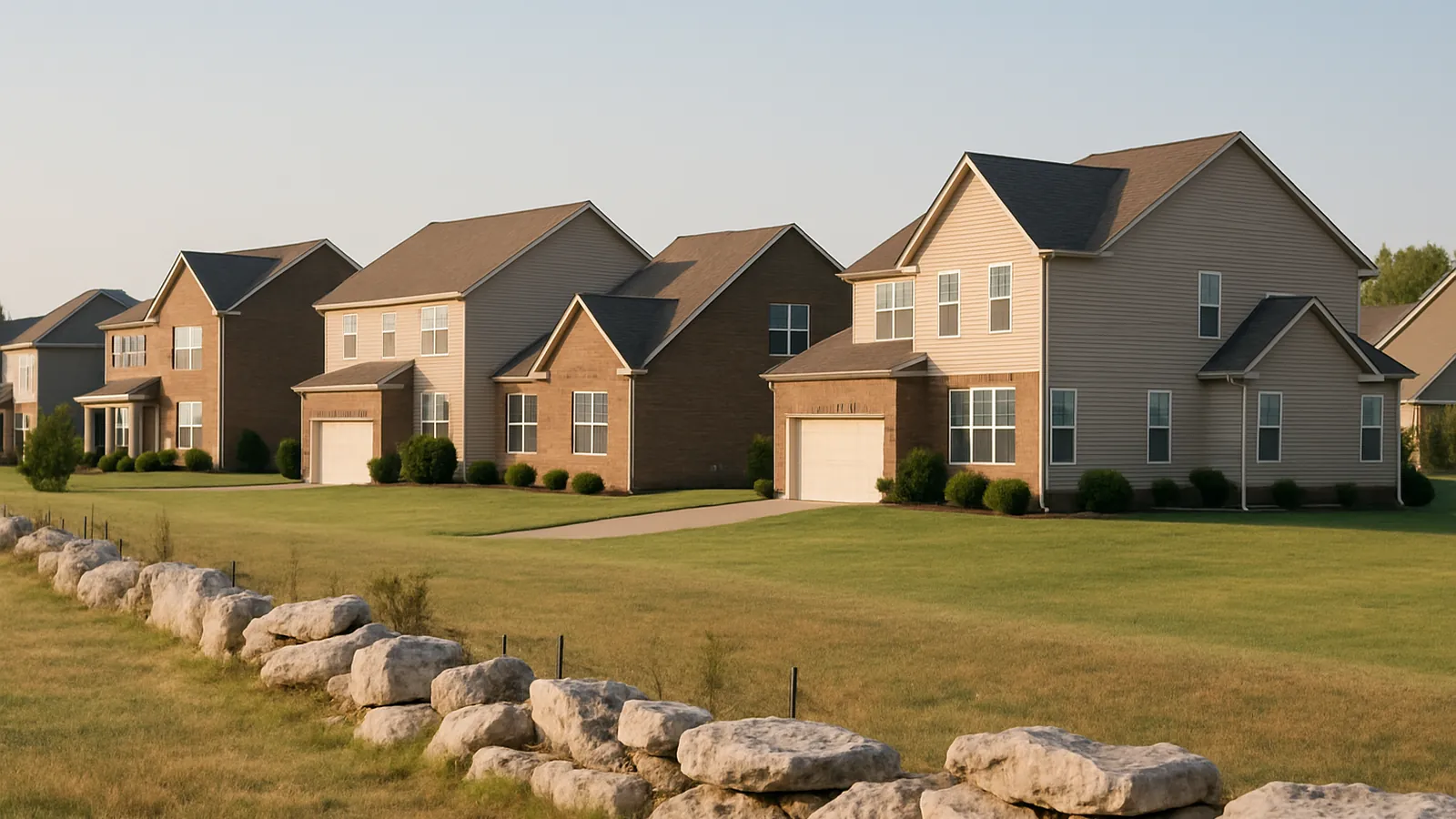
Foundation repair in Murfreesboro costs $4,000–$15,000 for most full repairs, with piers commonly $1,200–$3,000 each. Rutherford County's residual clay sits shallow over Ordovician limestone, so bearing depth can change dramatically across one lot — which is what drives settlement here.
Below: the symptoms that matter, why this ground behaves the way it does, and what each repair actually involves.
What a moving foundation looks like from inside
Foundations report trouble upstairs before anyone looks at a footing:
- Stair-step cracks through brick or block — masonry following a footing that dropped
- Doors and windows racking out of square, often seasonally at first
- Diagonal drywall cracks running from door and window corners
- Floors sloping toward one wall, or gaps under baseboards
- Interior slab cracks telegraphing through tile or luxury vinyl
- Separation where brick meets a porch column or where an addition joins the original house
One symptom is worth a dated pencil mark and a season of watching. Two or more — or anything that widens between spring and August — is worth a measured evaluation while the fix is still a few piers.
Thin soil, hard rock, uneven bearing
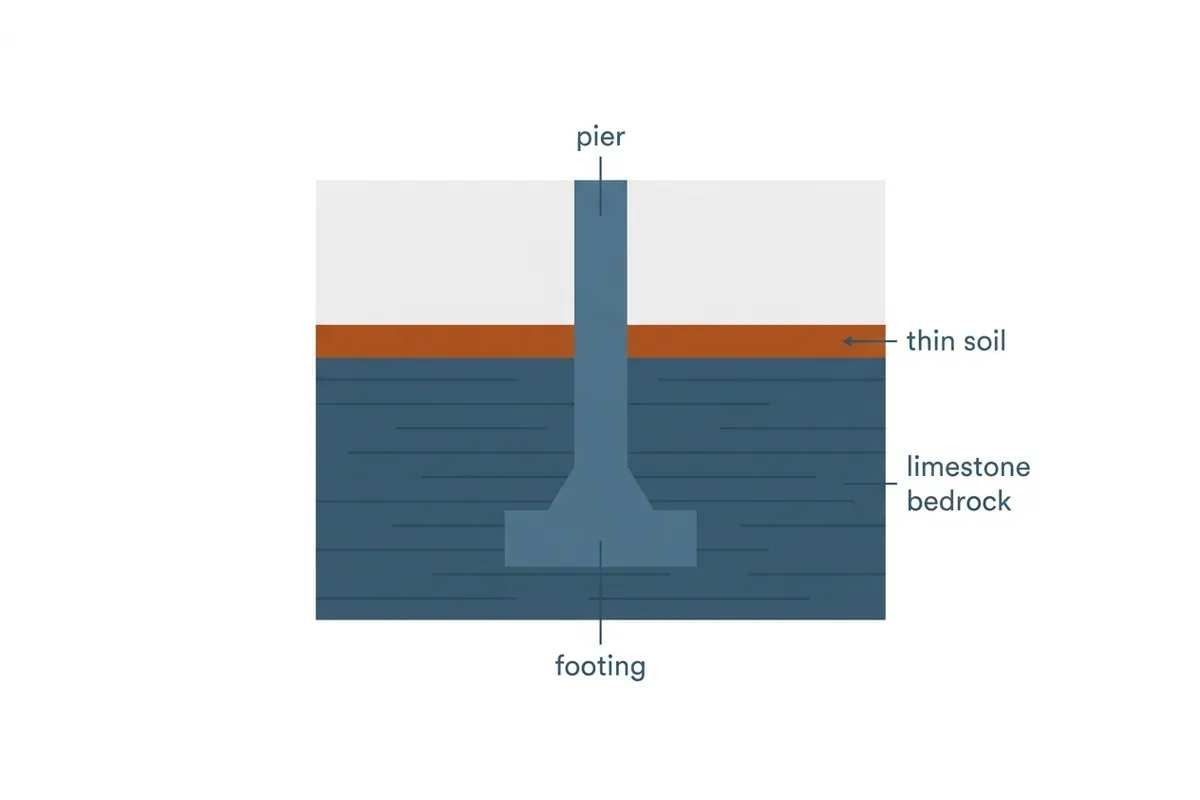
Murfreesboro sits in Tennessee's Central Basin, where residual clays formed in place over Ordovician limestone. Two facts about that combination drive nearly every foundation problem in Rutherford County.
First, the clay above the rock behaves like clay everywhere: it swells when saturated through wet middle-Tennessee winters and contracts through dry late summers, cycling pressure against footings. Second — and this is what makes the county distinctive — the depth to rock is irregular. Limestone surfaces are rarely flat; groundwater has dissolved and channeled them over geological time. One corner of a house may rest on soil a couple of feet deep while another sits over a pocket several feet deeper. When the clay cycles, those two corners move by different amounts, and the structure spans the difference.
That irregularity is also why this county carries documented karst features — sinkholes, solution cavities, and springs mapped throughout the basin. Most local foundation work is ordinary clay settlement. But settlement that appears suddenly, accelerates, or concentrates in a small area gets treated as a reason to investigate deeper before anyone drives a pier.
The repairs that fix Murfreesboro houses
| What you see | What's happening | The fix | Typical range |
|---|---|---|---|
| Stair-step cracks, dropped corners, sloping floors | Uneven bearing as clay cycles over irregular rock | Piers driven to refusal on rock | $4,000–$15,000 |
| Interior slab cracks, racked door frames | Differential movement under a slab-on-grade | Perimeter or interior slab support | $3,500–$12,000 |
| Cracks widening between seasons | Movement opening paths through masonry | Injection and reinforcement | $400–$1,500 |
| Water at the foundation, soggy ground | Roof and lot water feeding the moisture cycle | Grading, extensions, drains | Under $500–$6,000 |
| Sunken driveway, patio, or walkway panels | Fill consolidating over shallow soil | Polyurethane lifting | $500–$2,500 |
Multiple symptoms usually trace to one cause. Scoping them together is how the repair holds, and how you avoid paying two mobilizations for one ground problem.
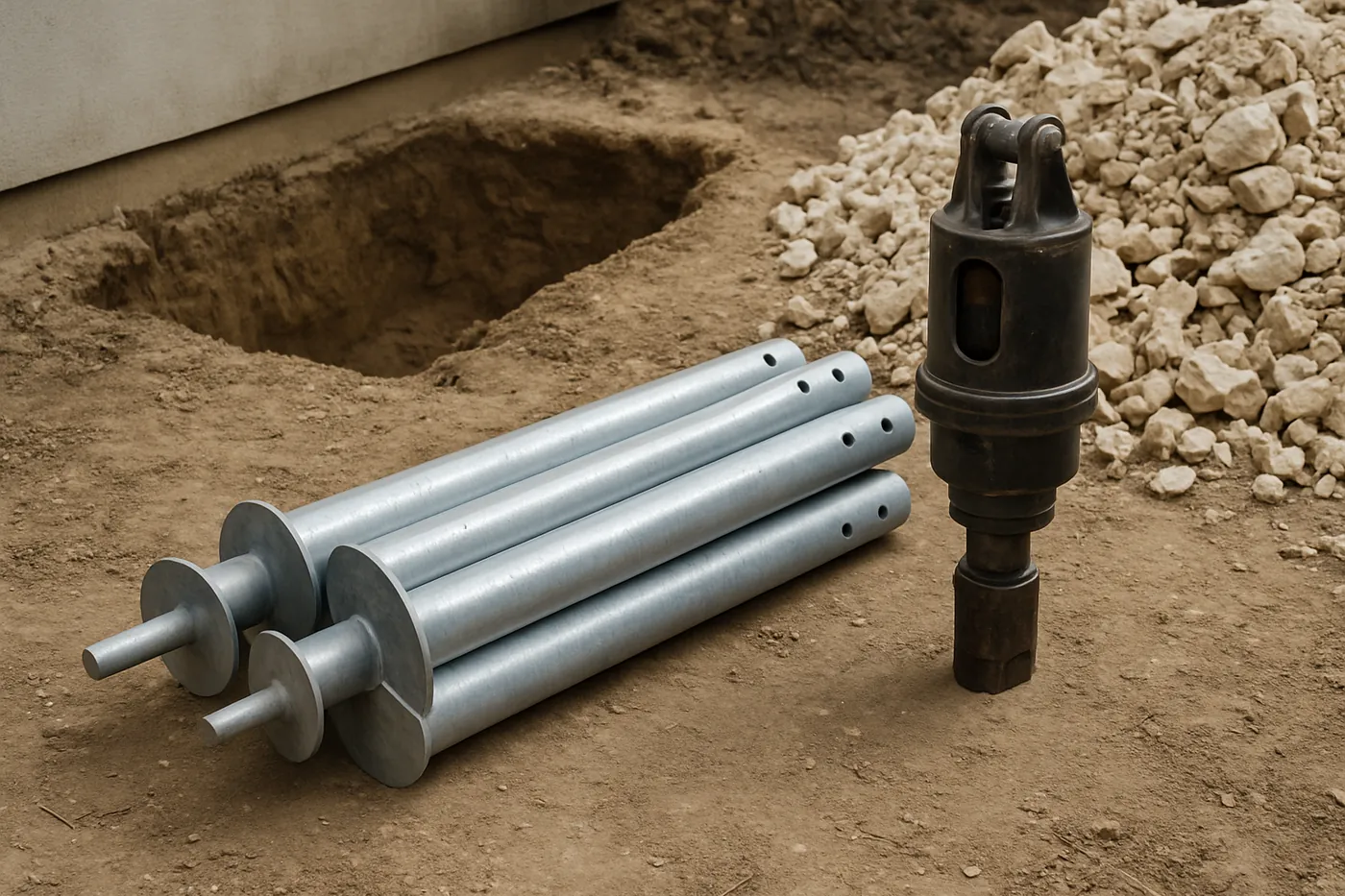
The decisions behind the table go deeper on their own pages: how we separate fill, clay, and karst settlement, when helical piers beat push piers through graded fill, what water management means without basements, how the sinkhole election and builder warranty change coverage, and when an independent structural engineer is worth the fee.
The subdivision question this county has to ask
Rutherford County has been one of Tennessee's fastest-growing counties for years, and that growth put thousands of homes on graded and filled lots. Engineered fill settles on a schedule of its own — hardest in the first decade, tapering after — while the native clay beneath keeps its seasonal rhythm regardless. So when a ten-year-old house in a newer subdivision starts cracking, the first diagnostic question isn't whether something is wrong; it's which layer is moving.
The answer changes the repair. Fill settlement calls for piers that pass entirely through the fill to native bearing. Clay cycling over shallow rock calls for a different depth specification entirely. Getting that wrong means installing piers that ride the same moving layer they were meant to escape.
How the evaluation works
We walk the house inside and out: crack widths measured and photographed, floor elevations shot with a laser, grading and downspouts traced for the water story, and the plat checked where fill is a possibility. You get a written scope naming the cause, the repair, the price per line, and the timeline — and when the honest answer is "mark it and watch it through one more dry season," that's what the report says. The evaluation is free either way.
Foundation repair questions Murfreesboro homeowners ask
How much does foundation repair cost in Murfreesboro?
Most full repairs run $4,000 to $15,000, with piers commonly $1,200 to $3,000 each and single crack repairs from about $400. What moves your number here is how deep the limestone sits under your lot, how many piers the survey justifies, and whether drainage work is needed. Every figure follows a free measured evaluation. Our Foundation repair cost breakdown for Murfreesboro shows what drives each figure, line by line.
Why do Rutherford County foundations move if we're sitting on limestone?
Because the soil above it isn't stable, and the rock below isn't uniform. Central Basin residual clays shrink and swell with moisture like clays anywhere, and they often sit shallow over irregular limestone — so one corner of a house may bear on rock a few feet down while another bears on several feet of clay. That difference is what produces settlement.
Should I be worried about sinkholes in Murfreesboro?
Worth understanding, not worth panicking over. Middle Tennessee is documented karst country — limestone that groundwater has dissolved over time, producing sinkholes and solution cavities. Most foundation problems here are ordinary clay movement, not karst collapse. But settlement that appears suddenly, accelerates, or localizes to one small area gets treated as a flag for deeper investigation rather than routine piering.
My subdivision home is only ten years old. Why is it cracking?
Rutherford County's growth put a lot of houses on graded fill, and fill consolidates on its own decade-long schedule while the clay beneath keeps cycling with the seasons. A crack appearing at year eight to twelve is a recognized pattern here. What matters is the trajectory — fill settlement slows over time, clay movement breathes with the weather, and a dated pencil mark across one full year separates them.
How deep do piers go around here?
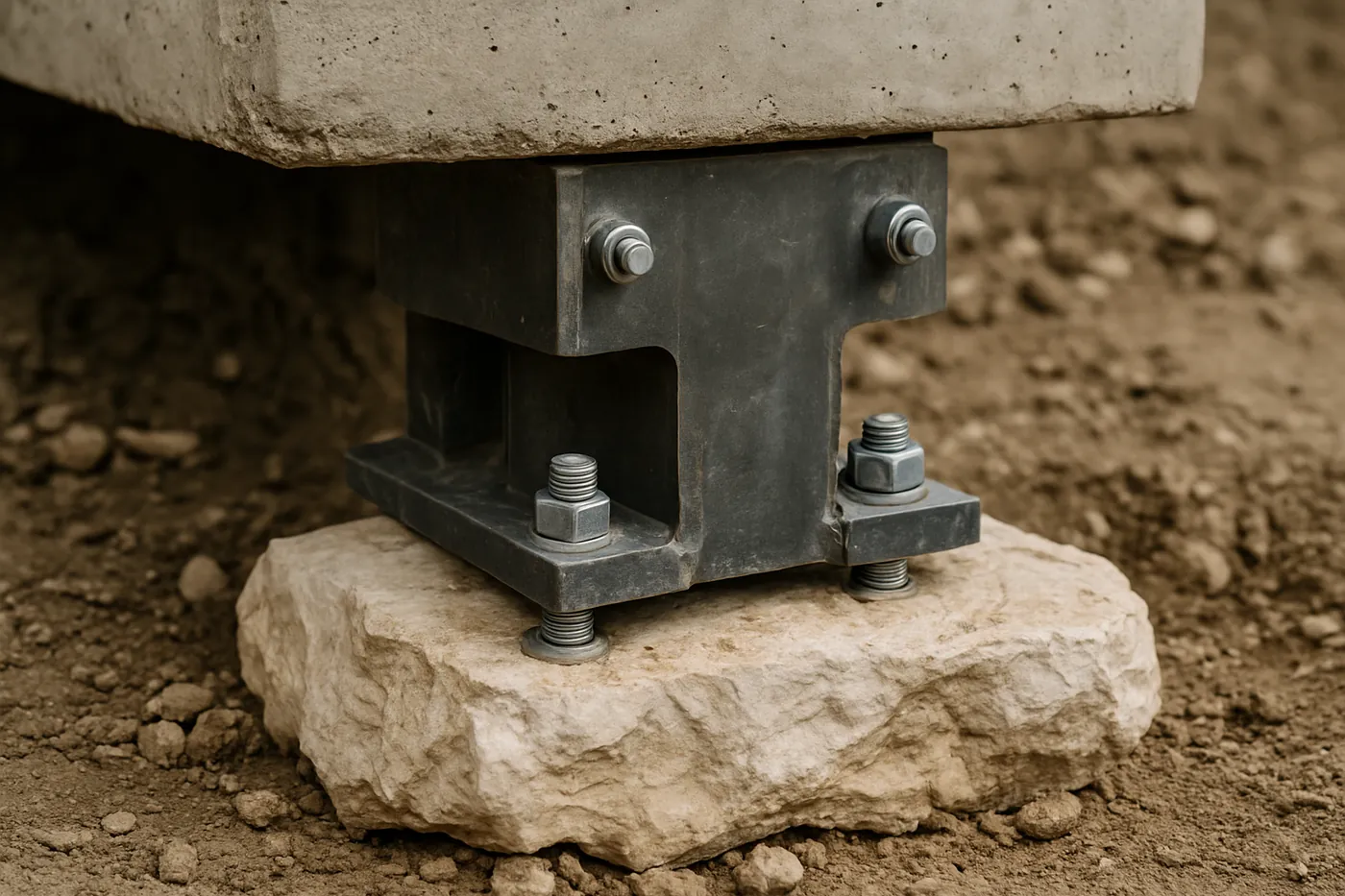
Often less than in deep-clay markets, and that's a genuine cost advantage. Where limestone sits within reach, piers can find stable bearing relatively shallow. Where the rock drops away or the soil is deeper, piers go further. Because depth varies lot to lot — sometimes within one lot — we drive each pier to its own refusal and log the pressure rather than quoting a standard depth.
Are stair-step cracks in my brick serious?
It depends on width and whether they're moving. Hairline stair-steps that hold still through a full wet-dry cycle are common and often just the house settling into its ground. Cracks past a quarter inch, cracks that widen between spring and late summer, or cracks paired with sloping floors indicate active movement and deserve measurement.
Does drainage matter as much here as in other markets?
It matters differently. Thin soil over rock can shed water fast in some spots and trap it in others, and karst terrain moves groundwater in ways surface grading doesn't predict. Roof water dumped at the foundation still causes the classic moisture differential, so extensions and grading lead our scopes — but here we also walk where the water goes after it leaves your lot.
Will insurance cover foundation repair?
Usually not. Standard homeowner policies exclude earth movement and settling. Some Tennessee policies offer separate sinkhole coverage, which is worth checking if your situation involves genuine karst activity rather than ordinary clay settlement. We document cause during the evaluation, which is what any claim conversation requires.
Foundation repair across Rutherford County and beyond
Smyrna · La Vergne · Christiana · Eagleville · Rockvale · Woodbury · Shelbyville · Lebanon · Franklin · all service areas
Get a free Murfreesboro foundation evaluation
Tell us what the house is doing — stair-step cracks, doors that stick every August, sloping floors, separating trim — and we’ll schedule an evaluation with photos and measurements. We reply the same business day.